Your reading vitals
3 min read
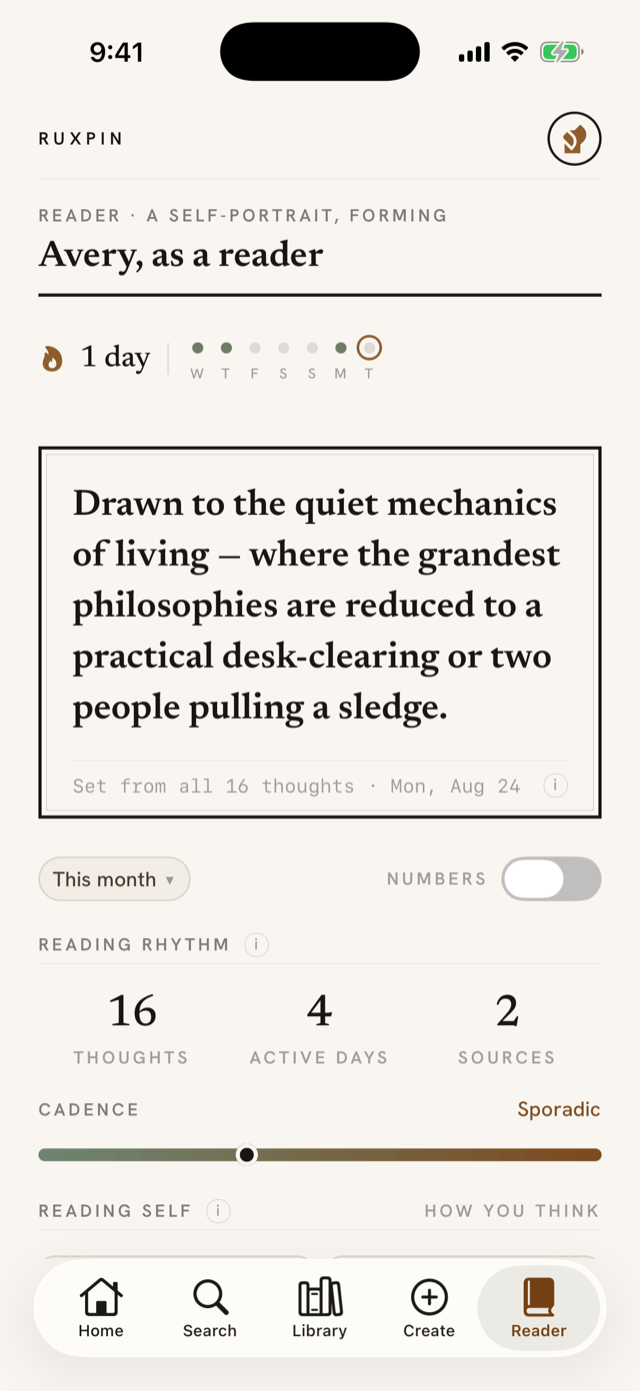
The Reader tab draws you as a reader, a small set of vitals you can watch over time. This guide explains what they mean and how each is worked out, so nothing on the tab is a black box.
Two kinds of vital
Reading self is how you think when you read: six leans, each sitting somewhere between two poles.
- Inquiry: Absorbing ↔ Questioning
- Reflection: Outward ↔ Inward
- Range: Focused ↔ Wide
- Synthesis: Siloed ↔ Woven
- Craft: Ideas ↔ Language
- Immersion: Detached ↔ Immersed
These are leans, not grades. Reading "Focused" isn't worse than "Wide," and "Absorbing" isn't worse than "Questioning". They're just different ways to read, and the dot shows where you sit.
Reading rhythm is how you show up: your Cadence (Sporadic ↔ Steady) and this month's counts: entries, active days, and sources. These are plain facts, so they show their actual numbers.
Where the vitals come from
We don't hand you a personality quiz. The six identity vitals are built on Openness to Experience, the Big Five trait most tied to curious reading and abstract thinking, whose six well-studied facets our six vitals map onto one for one. Cadence comes from a second Big Five trait, Conscientiousness.
They are inferred from what you capture, not measured by a test: a mirror for reflection, not a diagnosis.
How the numbers are worked out
Every vital is built from things we can literally count in your own record, never a vibe. A few rules hold everywhere:
- Everything is counted over your entries, and a long entry counts the same as a short one.
- "This month" means your last 30 days, a rolling window rather than a calendar reset.
- Each vital is a blend of two or three ingredients, each of which is just a rate ("2 of 3 entries open a question") or a count with a fixed scale ("across 3 sources"). Tap any vital to see exactly what fed it, the raw values, and the real entries behind it.
- The formula never changes month to month, so the trend line is an honest comparison of you against yourself.
Almost everything is a plain count. The one exception is Reflection's "inward turn", meaning whether an entry connects the book to your own life, which is a judgment made once, when the entry is first saved, and then just counted like anything else. The entries it counted are shown to you as evidence.
When a vital looks the way it does
Some vitals read forming for a while, two of them measure your whole record rather than the last month, and Immersion takes longer than the rest. When vitals appear explains each of those.
Sharing, the epigraph, and each vital's note
The tab's Share your record control turns your counts into a card you can post or send; Sharing your record covers what is on it. The line at the top of the tab, your epigraph, and the short "what this could mean" note inside each vital are set from your entries in a dated weekly impression, unlike the numbers, which are worked out live every time the tab opens. The weekly impression covers how and when.